
How Large Companies Really Use WordPress
Four in ten websites worldwide run on WordPress, 40.2% to be exact (W3Techs). Among the homepages of Germany’s DAX companies, our check found a share of zero. Even so, SAP, Siemens, Rheinmetall, and DHL Group rely on WordPress, just in other places.
In many corporations, one assumption shapes the choice of system: a large website needs an enterprise system, and WordPress is for blogs. We checked around 140 websites belonging to the 40 companies in the DAX, Germany’s leading stock index. For the homepages, the assumption holds. They mostly run on Adobe Experience Manager, Sitecore, TYPO3, or Drupal. Below the homepage, several companies use WordPress: SAP for its global newsroom with country editions, Airbus for the website of its US subsidiary, Qiagen for that of its Digital Insights business unit.
That makes market share a weak argument for choosing a system, in either direction. What tells you more is what large organizations use WordPress for, and when they turn to other systems.
At a Glance
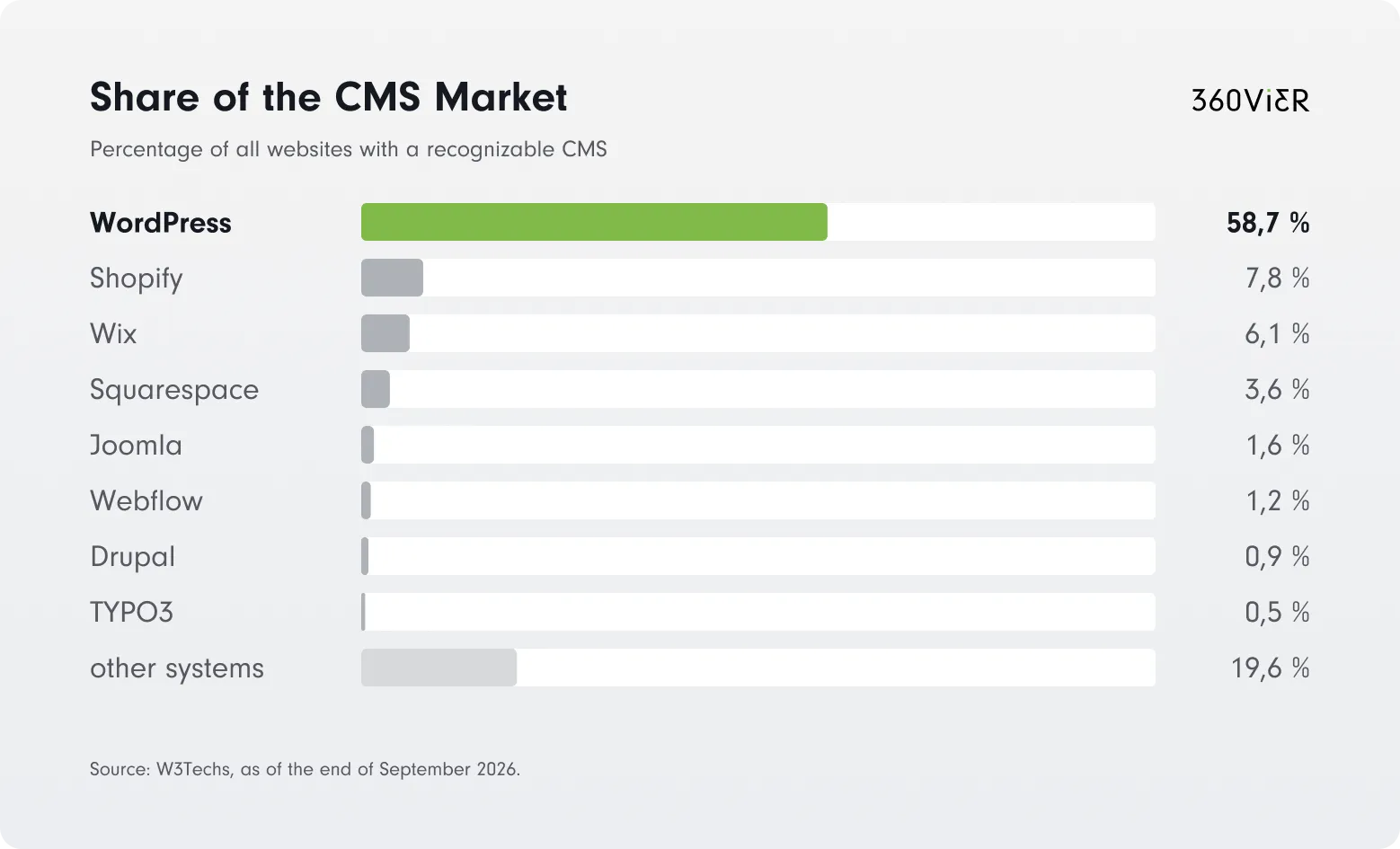
- 40.2% of all websites use WordPress. Counting only websites with an identifiable CMS, it is 58.7% (W3Techs).
- On .de domains, WordPress holds 54.1% of websites with an identifiable CMS, followed by TYPO3 at 6.7%.
- Among the 1,000 most visited websites with an identifiable CMS, WordPress sits at 50.4%.
- The share has been falling since early 2025. Growth goes mainly to Shopify, website builders, and websites without a traditional CMS.
- In the DAX sample, companies run newsrooms, magazines, and subsidiary websites on WordPress, while every homepage runs on another system.
How Many Websites Use WordPress in 2026
W3Techs publishes two figures that people often mix up. The share of all websites includes sites without an identifiable CMS, such as custom builds, static HTML, or frameworks like Next.js. The market share only counts websites whose CMS W3Techs can identify. For 31.5% of all websites, W3Techs finds no traditional CMS at all.
In e-commerce, too, a WordPress component leads. The WooCommerce shop extension accounts for 47.7% of all e-commerce systems in the W3Techs survey, Shopify for 32.1%.
Why the Numbers Differ by Source
Search for WordPress market share and you will find figures between 33% and 43% for the share of all websites, and between just under 59% and over 70% for the CMS market. The range comes from different samples and counting methods.
W3Techs analyzes around ten million of the most visited websites and counts subdomains as part of their main domain. HTTP Archive crawls websites from the Chrome User Experience Report, meaning sites with measurable Chrome traffic, and counts every subdomain separately. HTTP Archive’s Web Almanac 2025 puts WordPress at 35.0% of all mobile websites and 64.3% of websites with a CMS for July 2025. GravityKit analyzed the HTTP Archive data for April 2026 and measured 33.2% of all websites.
How the Share Has Changed Since 2015
According to the W3Techs time series, WordPress stood at 23.3% of all websites in early 2015 and 35.4% in early 2020. In early 2025 it reached its peak of 43.6%. Since then the figure has been falling, to 43.2% in December 2025, 41.9% at the end of May 2026, and 40.2% at the end of September 2026. HTTP Archive puts the peak earlier, in July 2022, at 35.8% of mobile websites.
An analysis by GravityKit based on HTTP Archive data shows where the share is going: of the growth of other systems over the past year, around 59% went to Shopify and around 16% to builders like Framer, Webflow, and Duda. At W3Techs, the group that grows most is websites without an identifiable CMS, up from 28.6% in January 2025 to 31.5% at the end of September 2026. Yoast founder Joost de Valk sees one reason in AI tools: if you can change a website by chat, you no longer need an editorial interface. That link has yet to be proven.
Many articles name the legal dispute between Automattic and the host WP Engine, which began in September 2024, as the cause. The timing fits only partly, because WordPress reached its peak after that.
WordPress in Germany
On .de domains, WordPress holds 54.1% of websites with an identifiable CMS. TYPO3 follows at 6.7%, Shopify at 4.9% (W3Techs). Worldwide, TYPO3 holds only 0.5% of the CMS market, but in Germany W3Techs ranks it second. In our DAX sample, five homepages run on TYPO3, including Continental, Daimler Truck, and MTU Aero Engines.
How Widespread WordPress Is Among Large Websites
A common objection is that WordPress is a system for small websites. The numbers by traffic rank paint a mixed picture. Among the most visited websites with an identifiable CMS, WordPress holds about half, which is below its overall figure of 58.7%. Still, it ranks first in every size bracket.
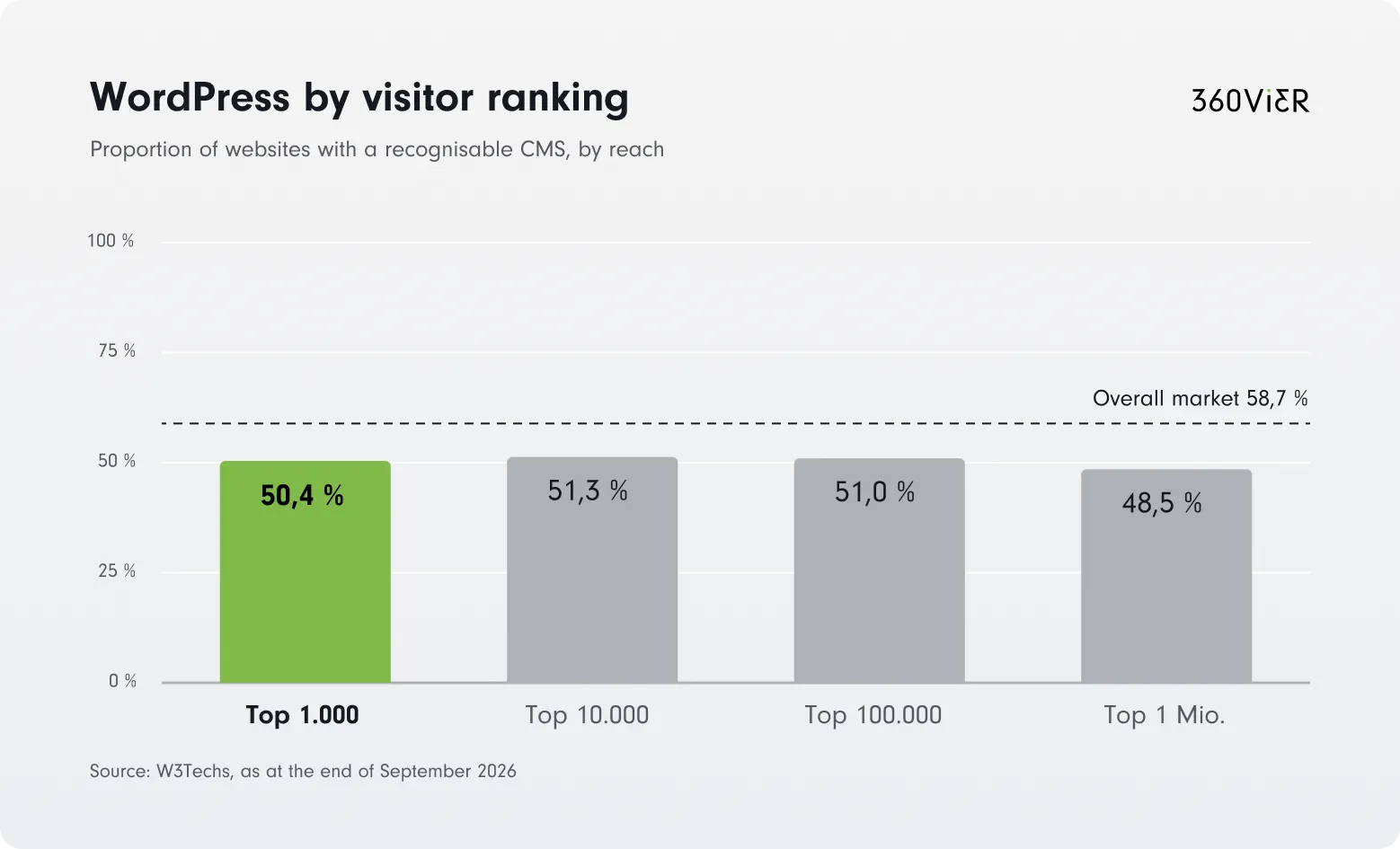
For large organizations, the top end matters most. Among the 1,000 most visited websites in the world with an identifiable CMS, every second one runs on WordPress, 50.4% to be exact (W3Techs). That makes WordPress the most widely used system even where reach and load are highest.
These numbers show how widespread a system is. Whether it suits a large website depends on the requirements, such as editorial workflows, languages, interfaces, security, and operations. There is also a gap in the count: custom builds and systems that W3Techs does not recognize as a CMS are missing from it entirely.
Where DAX Companies Use WordPress
How We Checked
For each of the 40 DAX companies, we checked up to six public websites: the corporate homepage, newsroom, careers portal, magazine or blog, and key brand and country sites. That came to around 140 websites in total. A site only counts as a WordPress website if its REST API at /wp-json/ returns the WordPress namespace wp/v2, its RSS feed names WordPress as the generator, or its files sit in the WordPress directory wp-content. We counted websites that blocked the request as not checkable. Further country and campaign sites were outside the sample.
Survey period: September 29 to October 6, 2026. The market figures come from W3Techs, as of the end of September 2026.
The Result
None of the corporate homepages we could check uses WordPress. Adobe Experience Manager (AEM) shows up most often, for example at Allianz, BMW Group, Deutsche Telekom, and E.ON. Bayer and Beiersdorf use Sitecore. Continental, Daimler Truck, MTU, Scout24, and Symrise work with TYPO3, Fresenius, Heidelberg Materials, and Zalando with Drupal. Careers portals are mostly provided by HR vendors such as SAP SuccessFactors, Workday, or Phenom.
Six companies run at least one website on WordPress:
SAP
news.sap.com: global newsroom with its own country editions, including Germany, France, Spain, and Japan.Siemens
blog.siemens.com and blogs.sw.siemens.com: the Siemens Blog and the Siemens Digital Industries Software blog network with more than 40 topic blogs.Rheinmetall
dimensions-magazin.de: the corporate magazine “Dimensions” in German and English.DHL Group
lot.dhl.com: the trade magazine “Logistics of Things”, in several languages.Qiagen
digitalinsights.qiagen.com: website of the QIAGEN Digital Insights business unit.Airbus
airbusus.com: website of the US subsidiary Airbus U.S. Space and Defense.Source: 360VIER’s own check. Some websites of Henkel, HOCHTIEF, and E.ON could not be checked. Six out of 40 is therefore a lower bound.
What the WordPress Websites Have in Common
According to their REST APIs, Rheinmetall, DHL, and Qiagen manage their multilingual content with the WPML plugin. Siemens bundles more than 40 topic blogs in one network, and SAP runs its newsroom with the tools of managed host WP Engine. Several languages, many sub-sites, professional operations: these are the same requirements a corporate homepage has. In these cases, they run on WordPress.
Why the homepages run on other systems can only be guessed from the outside. Existing license agreements, a group-wide platform strategy, or integration with marketing tools are possible reasons.
WordPress Outside the DAX
Outside the DAX, WordPress also runs central websites. For comparison, we checked a selection of well-known organizations using the same method. For these, WordPress ran the homepage or the corporate newsroom.
Corporate Websites
- REWE Group
- Capgemini, global website
- A1 Group (Telekom Austria), as a multisite
- Doppelmayr
- Ringier
- CANCOM, as a multisite
- Delivery Hero
Government, Media, and Newsrooms
- NASA and the White House
- Free State of Bavaria, state portal
- University of Freiburg
- swissinfo.ch of SRG SSR
- Corporate newsrooms of Meta, Microsoft, and Salesforce
How large such platforms get is shown in case studies from the enterprise host WordPress VIP, which means the figures come from the provider itself. Capgemini runs 38 WordPress sites with more than 20,000 pages in over ten languages for 40 markets. Before the move from Drupal to WordPress, the website depended on a handful of webmasters. Today, 70 people maintain the content themselves. The Times in London uses a decoupled WordPress for its website and apps. Its editors now need 62% fewer clicks to publish an article, which makes publishing 34% faster. Al Jazeera replaced more than six editorial systems with a decoupled WordPress for over 70 bureaus, including right-to-left Arabic script.
How Much Truth Is There in the Prejudices Against WordPress?
“Just a blogging system …”
Disproved.
Since 2010, WordPress has managed many websites from a single installation via Multisite, and since 2016 a REST API outputs all content in machine-readable form. Corporate websites like those of Capgemini and REWE Group run on it, as do government portals like nasa.gov and the news platform of The Times. When a decoupled frontend pays off is covered in our article on headless WordPress.
“Far too insecure …”
The risk lies with the plugins.
Patchstack counted 11,334 new vulnerabilities in the WordPress ecosystem in 2025. 91% were in plugins, while core had six, all of low priority. If you use few, well-maintained plugins and automate updates, you lower the risk considerably.
“Doesn’t scale …”
Disproved.
TIME served more than 100,000 requests per second on WordPress when its “Person of the Year” came out (case study). During the 2024 US presidential election, WordPress VIP served more than 22 billion requests, according to its own figures. How far a website scales comes down to caching, hosting, and architecture.
“Too slow …”
Partly justified.
According to the Web Almanac 2025, only 45% of mobile WordPress websites pass the Core Web Vitals, compared with 79% for TYPO3. That is mainly down to how many sites are built, for example with page builders like Elementor, which runs on around a third of all WordPress websites (GravityKit). A lean theme based on the block editor avoids the biggest slowdowns. Built well, a WordPress website passes the Core Web Vitals too.
What WordPress 7 Changes for Businesses
WordPress 7.0 came out on May 20, 2026. It adds an AI client to core and extends the Abilities API, introduced in 6.9, with a JavaScript interface. Plugins use it to describe their functions for AI agents. It also brings central management for external connections and a redesigned dashboard with a command palette. According to W3Techs, 63.8% of all WordPress websites have already moved to version 7.
This is already visible in our survey. Three of the websites we checked already use the Abilities API, and two of them also speak the Model Context Protocol (MCP). Through it, AI assistants can work directly with a website. If you want to open your content to AI search and agents, the groundwork is now in core. How companies become visible in AI answers is covered on our page about AI visibility.
What the Numbers Mean for Businesses Now
The decline goes mainly to Shopify, to builders like Framer and Webflow, and to websites without a traditional CMS, meaning systems for online stores, smaller sites, and custom builds. Among the 1,000 most visited websites with an identifiable CMS, WordPress ranks first, with about half the market.
In the DAX sample, the line runs between the homepage and everything below it. The same companies whose homepage runs on another system operate their newsrooms, magazines, and subsidiary websites on WordPress. For corporations, the question is therefore which part of their web presence WordPress fits. Outside the DAX, companies like REWE Group and Capgemini run their central website entirely on WordPress. As a WordPress agency, we restructured more than 22,000 pages for 165 locations for Lernstudio Barbarossa, as described in the case study.
How WordPress compares with TYPO3, Drupal, and other open-source systems is covered in our article A Comparison of Open-Source CMSs.
Frequently Asked Questions
What is the WordPress market share in 2026?
According to W3Techs, 40.2% of all websites use WordPress. Among websites with an identifiable CMS, the figure is 58.7%. HTTP Archive measures lower values with a different sample, 35.0% of all mobile websites in July 2025. Both sources see WordPress in first place by a wide margin. At W3Techs, Shopify follows with 5.4% of all websites.
Is WordPress losing market share?
Yes. According to W3Techs, the share fell from its peak of 43.6% in early 2025 to 40.2% most recently. The losses go mainly to Shopify, to builders like Framer and Webflow, and to websites without an identifiable CMS, which likely include AI-generated sites. Among the top 1,000 with an identifiable CMS, WordPress sits at 50.4%.
Which CMS is most widely used in Germany?
WordPress. On .de domains it holds 54.1% of websites with an identifiable CMS. TYPO3 comes second with 6.7%, Shopify third with 4.9% (W3Techs). TYPO3 is much stronger in Germany than worldwide, where it holds only 0.5% of the CMS market.
Do DAX companies use WordPress?
Six of the 40 DAX companies verifiably run at least one website on WordPress: SAP, Siemens, Rheinmetall, DHL Group, Qiagen, and Airbus. That is the result of our check of around 140 corporate websites. The companies use WordPress for newsrooms, magazines, blog networks, and subsidiary websites. Their homepages mostly run on Adobe Experience Manager, Sitecore, TYPO3, or Drupal.
Which large companies use WordPress for their main website?
In our check, the corporate websites of REWE Group, Capgemini, A1 Group, Ringier, Doppelmayr, CANCOM, and Delivery Hero, among others, ran on WordPress. So did nasa.gov, whitehouse.gov, the Bavarian state portal bayern.de, and the website of the University of Freiburg. Meta, Microsoft, and Salesforce run their corporate newsrooms on WordPress.
Is WordPress secure enough for businesses?
In WordPress core, Patchstack found only six vulnerabilities in 2025, all of low priority. 91% of the 11,334 newly reported vulnerabilities affected plugins, 9% themes. How secure a corporate website is therefore depends on the choice of plugins, fast updates, and hosting. Providers like WordPress VIP are SOC 2 Type 2 certified.
Is WordPress suitable for large websites?
Yes, if the architecture and hosting fit. The market data first shows how widespread it is: among the 1,000 most visited websites with an identifiable CMS, about half use WordPress. Whether it fits a specific project only becomes clear when you match it against your own requirements, from interfaces and security policies to operating costs. How we build such a platform is described on our page about WordPress architecture.
What Your Choice of System Depends On
The CMS you need follows from your editorial team, your languages, and the systems that need to be connected. These factors decide, more than any market share.

Which part of your web presence fits WordPress?
Show us your website landscape, from the homepage to the newsroom. We will tell you where WordPress fits and where another system works better.